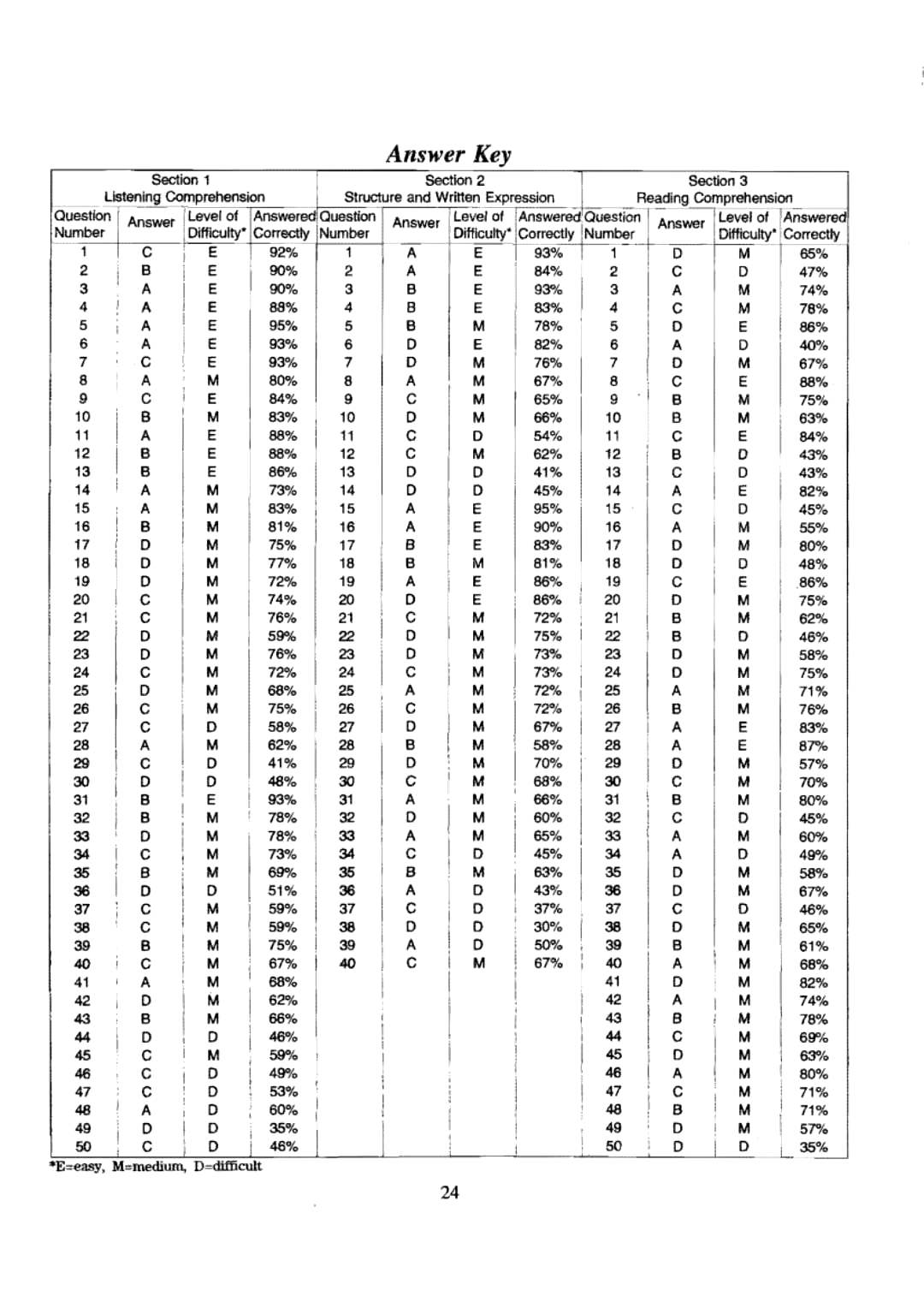
考题采用集团公司15套试题第一套完整原题,与5月份入职考试类似,5月采用第10套原题。
5月考试详情请戳:勘探院2020年中石油托福-快来对答案啦!
听力音频及原文,请戳:中石油托福-集团公司15套汇总
答案在题目后面!听力音频在微信公众号:油气储运干货分享大师兄
SECTION 1: LISTENING COMPREHENSION
1.
(A) Go to the movies with the man.
(B) Take her brother to the movies.
(C) Eat at her brother’s.
(D) Cook dinner with Lois.
2.
(A) The man should have offered his assistance earlier.
(B) She doesn’t need the man’s help.
(C) She didn’t realize the boxes were empty.
(D) She wants the man to move the boxes.
3.
(A) He’d like to have the windows open.
(B) He rarely leaves the windows open.
(C) He thinks the air is polluted.
(D) He’ll help her close the windows.
4.
(A) The results might be ready tomorrow.
(B) The man needs another test tomorrow.
(C) The results were called in last night.
(D) The doctor called the lab last night.
5.
(A) She doesn’t remember much about Portland.
(B) She’s never been to Portland.
(C) She knows someone else who could help him.
(D) She’d be happy to talk to the man later.
6.
(A) Turn down the volume.
(B) Help the man study for a test.
(C) Play a different kind of music.
(D) Speak louder.
7.
(A) She forgot when the report was due.
(B) She’d like the man to help her with the report.
(C) She needs more time to finish the report.
(D) She hasn’t included any data in her report.
8.
(A) The cat is a lot of trouble.
(B) The cat is quite friendly.
(C) The doesn’t get along with Debbie.
(D) He’s glad Debbie gave him the cat.
9.
(A) Try to get a seat next to the window.
(B) Find another passenger going to Cleveland.
(C) Ask for information about the departure.
(D) Find out if there are any seats left on the bus.
10.
(A) She forgot to stop at the store.
(B) The man shouldn’t eat the fish.
(C) The fish is safe to eat.
(D) The food shouldn’t be reheated.
11.
(A) She won’t be able to go with the man.
(B) She doesn’t think Frank is arriving until tomorrow morning.
(C) She has to pick up Frank at 2:00.
(D) She doesn’t know when her class will end.
12.
(A) He watched the television program with his mother.
(B) His mother told him his professor was on television.
(C) Answering the phone caused him to miss the television program.
(D) His mother missed the television program.
13.
(A) The pool will be open all week.
(B) The weather will cool down soon.
(C) The woman should go swimming.
(D) He prefers to stay inside in hot weather.
14.
(A) He may not have enough time to cook.
(B) He may spend more money on food next semester.
(C) He may gain weight if he does his own cooking.
(D) He may not enjoy cooking.
15.
(A) He’s tired.
(B) He lost the race.
(C) He has already been to the top of the hill.
(D) He prefers doing exercise indoors.
16.
(A) The doctor only has time on Tuesdays.
(B) The doctor is busy on Tuesday morning.
(C) The man must come more than one time.
(D) The man must arrive on time.
17.
(A) Eat dinner at the cafeteria.
(B) Find out when the cafeteria opens.
(C) Meet her in the cafeteria this evening.
(D) Try to get a job at the cafeteria.
18.
(A) Drive on through the night.
(B) Check out of the motel.
(C) Cancel their motel reservations.
(D) Stop driving for the rest of the day.
19.
(A) She doesn’t want to take the course this semester.
(B) She thought the class would be easy.
(C) She will have thirteen credits after she completes the class.
(D) She’s surprised that all the sections are filled.
20.
(A) She doesn’t like to drink coffee.
(B) She’s not upset by the accident.
(C) The man should apologize.
(D) The man has spilled coffee on her before.
21.
(A) The man will have to buy a new shirt.
(B) The shirt looks just like the man’s new one.
(C) The shirt can be repaired easily.
(D) The man shouldn’t put sharp objects in his shirt pocket.
22.
(A) The jackets sold out quickly.
(B) The sale ended yesterday.
(C) He’ll check with the sales clerk.
(D) The woman might find a jacket on sale.
23.
(A) She likes to drive when she travels.
(B) She doesn’t want to go to Chicago.
(C) She doesn’t know how much the train trip will cost.
(D) It’s cheaper to go to Chicago by car.
24.
(A) The man paid a lot to join the gym.
(B) The man has been working too hard.
(C) The man has improved his physical condition.
(D) The man should ask for more pay.
25.
(A) She prefers hot weather.
(B) The man should visit Washington when it’s cooler.
(C) She agrees that going to the beach would have been better.
(D) Visiting Washington is enjoyable despite the heat.
26.
(A) She’ll help the man clean up the spill.
(B) Timmy should be more careful.
(C) The man should be more understanding.
(D) Timmy isn’t well behaved for his age.
27.
(A) He can meet the woman on Wednesday.
(B) He won’t be ready until next week.
(C) He’s available any day except Wednesday.
(D) He needs to do the history project before Wednesday.
28.
(A) Go to a field hockey practice.
(B) Try out for the field hockey team.
(C) Get tickets to see the championship game.
(D) Receive an award for winning a championship.
29.
(A) She wants to check the weather before deciding.
(B) She has a problem with her hearing.
(C) She’d enjoy coming to dinner another time.
(D) She wants the man to help her with some work.
30.
(A) The back of the drawer has fallen off.
(B) The man doesn’t have any soap.
(C) The cabinet is too heavy to move.
(D) Something is blocking the back of the drawer.
31.
(A) There aren’t enough cabinets.
(B) There is too much noise.
(C) Office supplies are taking up space.
(D) Some teaching assistants don’t have desks.
32.
(A) To chat with Jack socially.
(B) To get help in the course.
(C) To hand in their assignments.
(D) To practice giving interviews.
33.
(A) Give Jack a different office.
(B) Complain to the department head.
(C) Move the supplies to the storage room.
(D) Try to get a room to use for meetings.
34.
(A) They’d have to get permission.
(B) Jack wouldn’t like it.
(C) She thinks it might work.
(D) The other assistants should be consulted.
35.
(A) Mating habits of squid and octopus.
(B) The evolution of certain forms of sea life.
(C) The study of marine shells.
(D) Survival skills of sea creatures.
36.
(A) He didn’t understand the lecture.
(B) He wants to borrow her notes next week.
(C) He needs help with a makeup exam.
(D) He was sick and unable to attend.
37.
(A) Some sea creatures developed vertebrae.
(B) The first giant squid was captured.
(C) Some sea creatures shed their shells.
(D) Sea life become more intelligent.
38.
(A) She has always believed they exist.
(B) She heard about them in New Zealand.
(C) Stories about them may be based on giant squid.
(D) The instructor mentioned them in the lecture.
39.
(A) To explain a new requirement for graduation.
(B) To interest students in a community service project.
(C) To discuss the problems of elementary school students.
(D) To recruit elementary school teachers for a special program.
40.
(A) To find jobs for graduating students.
(B) To help education majors prepare for final exams.
(C) To offer tutorials to elementary school students.
(D) To provide funding for a community service project.
41.
(A) He advises students participating in special program.
(B) He teaches part-time in an elementary school.
(C) He observes elementary school students in the classroom.
(D) He helps students prepare their resumes.
42.
(A) Contact the elementary school.
(B) Sign up for a special class.
(C) Submit a resume to the dean.
(D) Talk to Professor Dodge.
43.
(A) To prepare students for the next reading assignment.
(B) To provide background information for a class discussion.
(C) To review material from a previous lesson.
(D) To prepare for a quiz on chapter six.
44.
(A) Insurance companies.
(B) Sailors.
(C) Manufacturers.
(D) Merchants.
45.
(A) The distance the merchandise had to be shipped.
(B) The number of insurance companies available at the time.
(C) The amount of danger involved in shipping the goods.
(D) The type of vessel used to transport the goods.
46.
(A) Only four types of policies still exist today.
(B) They are cheaper than the ones in the Middle Ages.
(C) They include features similar to earlier policies.
(D) The interest rates are based on early methods of calculation.
47.
(A) The oxygen level in the water.
(B) The angle of the treadmill.
(C) The weights on the divers.
(D) The temperature of the water.
48.
(A) Walking on Mars will be easier than walking on the Moon.
(B) There is more gravity on the Moon than on Mars.
(C) Walking quickly will be difficult on Mars.
(D) Astronauts on Mars will require more oxygen than will astronauts on the Moon.
49.
(A) They took short, quick steps.
(B) They were pulled off of the treadmill.
(C) They lost their balance.
(D) They took longer coordinated steps.
50.
(A) Martian suits will have larger air tanks.
(B) Martian suits will be equipped with special weights.
(C) Martian suits will be more flexible.
(D) Martian suits will be less durable.
Section Two: Structure and Written Expression
1.Dairy farming is ___ leading agricultural activity in the United States.
(A) a
(B) at
(C) then
(D) none
2.Although thunder and lightning are produced at the same time, light waves travel faster___ , so we see the lightning before we hear the thunder.
(A) than sound waves do
(B) than sound waves are
(C) do sound waves
(D) sound waves
3.Beef cattle___ of all livestock for economic growth in certain geographic regions.
(A) the most are important
(B) are the most important
(C) the most important are
(D) that are the most important
4.The discovery of the halftone process in photography in 1881 made it___ photographs in books and newspapers.
(A) the possible reproduction
(B) possible to reproduce
(C) the possibility of reproducing
(D) possibly reproduced
5.Flag Day is a legal holiday only in the state of Pennsylvania,___ Betsy Ross sewed the first American flag.
(A) which
(B) where
(C) that
(D) has
6.___ Vastness of the Grand Canyon, it is difficult to capture it in a single photograph.
(A) While the
(B) The
(C) For the
(D) Because of the
7.Speculation,___ ,results when an animal population becomes isolated by some factor, usually geographic.
(A) form biological species
(B) biological species are formed
(C) which forming biological species
(D) the formation of biological species
8.In this pure state antimony has no important uses, but___ with other substances, it is an extremely useful metal.
(A) when combined physically or chemically
(B) combined when physically or chemically
(C) the physical and chemical combination
(D) it is combined physically and chemically
9.The dawn redwood appears___ some 100 million years ago in northern forests around the world.
(A) was flourished
(B) having to flourish
(C) to have flourished
(D) have flourished
10.Beginning in the Middle Ages, composers of Western music used a system of notating their compositions___ be performed by musicians.
(A) will
(B) that
(C) and when to
(D) so they could
11.Civil Rights are the freedoms and rights___ as a member of a community, state or nation.
(A) may have a person
(B) may have a person who
(C) a person may have
(D) and a person may have
12.Richard Wright enjoyed success and influence___ among Black American writers of his era.
(A) Were unparalleled
(B) are unparalleled
(C) unparalleled
(D) the unparalleled
13.___ Of large mammals once dominated the North American prairies the American bison and the pronghorn antelope.
(A) There are two species
(B) With two species
(C) Two species are
(D) Two species
14.Franklin D. Roosevelt was___ the great force of radio and the opportunity it provided
for taking government policies directly to the people.
(A) as the first President he understood fully
(B) the first president that to fully understand
(C) the first President fully understood
(D) the first President to understand fully
15.During the late fifteenth century___ of the native societies of America had professions in the fields of arts and crafts.
(A) only a few
(B) a few but
(C) few, but only
(D) a few only
16. The firstly naval battle of the Revolutionary War was fought off the coast of Machias, Maine
A B C
in June 1775.
D
17. The public ceremonies of the Plains Indians are lesser elaborate than those of the Navajo in
A B C
the Southwest.
D
18. In some species of fish, such the three-spined stickleback, the male, not the female, performs
A B C
the task of caring for the young.
D
19. When she retires in September 1989, tennis champion Christine Event was the most famous
A B C
woman athlete in the United States.
D
20. The ancient Romans used vessels equipped with sails and banks of oars to transporting their
A B C D
armies.
21. Dinosaurs are traditionally classified as cold-blooded reptiles, but recent evidence based on
A B
eating habits, posture and skeletal structural suggests some may have been warm-blooded.
C D
22. Since the Great Depression of the 1930’s, social programs such as Social Security have been
A B
built into the economy to help avert severity business declines.
C D
23. In the 1970’s consumer activities succeeded in promoting laws that set safety standards for
A B C
automobiles, children’s clothing and a widely range of household products.
D
24. Zoos in New Orleans, San Diego, Detroit, and the Bronx have become biological parks where
A B
animals roams free and people watch from across a moat.
C D
25. In human beings as in other mammal, hairs around the eyes and ears and in the nose prevent
A B C
dust, insects, and other matter from entering these organs.
D
26. The Rocky Mountains were explored by fur traders during the early 1800’s, in a decades
A B C
preceding the United States Civil War.
D
27. The works of the author Herman Melville are literary creations of a high order, blending fact
A B C
fiction, adventure, and subtle symbolic.
D
28. Each chemical element is characterized to the number of protons that an atom of that element
A B C
contains, called its atomic number.
D
29. The body structure that developed in birds over millions of years is well designed for flight,
A B C
being both lightly in weight and remarkably strong.
C
30. From 1905 to 1920, American novelist Edith Wharton was at the height of her writing career,
A B C
publishing of her three most famous novels.
D
31. In the early twentieth century, there was considerable interesting among sociologists in the fact
A
that in the United States the family was losing its traditional roles.
B C D
32. Although pure diamond is colorless and transparent, when contaminated with other material it
A B C
may appear in various color, ranging from pastels to opaque black.
D
33. Comparative anatomy is concerned to the structural differences among animal forms.
A B C D
34. A seismograph records oscillation of the ground caused by seismic waves, vibrations that travel
A B
from its point of origin through the Earth or along its surface.
C D
35. Electric lamps came into widespread use during the early 1900’s and have replaced other type
A B
of fat, gas, or oil lamps for almost every purpose.
C D
36. Located in Canada, the Columbia Icefield covers area of 120 square miles and is 3,30 feet
A B
thick in some places.
C D
37. R.Rodgers and O.Hammerstein brought to the musical Oklahoma extensive musical and theatrical
A B
backgrounds as well as familiar with the traditional forms of operetta and musical comedy.
C D
38. Because of its vast tracts of virtually uninhabited northern forest, Canada has one of the
A B C
lowest population density in the world.
D
39. Rice, which it still forms the staple diet of much of the world’s population, grows best in
A B C
hot, wet lands.
D
40. Government money appropriated for art in the 1930’s made possible hundreds of murals and
A B
statues still admiration in small towns all over the United States.
C D
Section Three: Reading Comprehension
Questions 1-10
The conservatism of the early English colonists in North American, their strong attachment to the English way of doing things, would play a major part in the furniture that was made in New England. The very tools that the first New England furniture makers used were, after all, not much different from those used for centuries-even millennia: basic hammers, saws, chisels, planes, augers, compasses, and measures.
These were the tools used more or less by all people who worked with wood: carpenters, barrel makers, and shipwrights. At most the furniture makers might have had planes with special edges or more delicate chisels, but there could not have been much specialization in the early years of the colonies.
The furniture makers in those early decades of the 1600's were known as "joiners", for the primary method of constructing furniture, at least among the English of this time, was that of mortise-and-tenon joinery. The mortise is the hole chiseled and cut into one piece of wood, while the tenon is the tongue of protruding element shaped from another piece of wood so that it fits into the mortise; and another small hole is then drilled (with the auger) thought the mortised end and the tenon so that a whittled peg can secure the joint-thus the term "joiner". Panels were fitted into slots on the basic frames. This kind of construction was used for making everything from houses to chests. Relatively little hardware was used during this period. Some nails-forged by hand-were used, but no screws or glue, hinges were often made of leather, but metal hinges were also used. The cruder varieties were made by blacksmiths in the colonies, but the finer metal elements were imported. Locks and escutcheon plates-the latter to shield the wood from the metal key-would often be imported.Above all, what the early English colonists imported was their knowledge of familiarity with, and dedication to the traditional types and designs of furniture they knew in England.
1.The phrase "attachment to" in line 2 is closest in meaning to
(A) control of
(B) distance from
(C) curiosity about
(D) preference for
2.The word "protruding" in line 13 is closest in meaning to
(A) parallel
(B) simple
(C) projecting
(D) important
3.The relationship of a mortise and a tenon is most similar to that of
(A) a lock and a key
(B) a book and its cover
(C) a cup and a saucer
(D) a hammer and a nail
4.For what purpose did woodworkers use an auger?
(A) to whittle a peg
(B) to make a tendon
(C) to drill a hole
(D) to measure a panel
5.Which of the following were NOT used in the construction of colonial furniture?
(A) Mortises
(B) Nails
(C) Hinges
(D) Screws
6.The author implies that colonial metalworkers were
(A) unable to make elaborate parts
(B) more skilled than woodworkers
(C) more conservative than other colonists
(D) frequently employed by joiners
7.The word "shield" in line 23 closest in meaning to
(A) decorate
(B) copy
(C) shape
(D) protect
8.The word "they" in line 25 refers to
(A) designs
(B) types
(C) colonists
(D) all
9.The author implies that the colonial joiners
(A) were highly paid
(B) based their furniture on English models
(C) used many specialized tools
(D) had to adjust to using new kinds of wood in New England
10.Which of the following terms does the author explain in the passage?
(A) "millennia" (line 5)
(B) "joiners" (line 10)
(C) "whittled" (line 15)
(D) "blacksmiths" (line 21)
Questions 11-20
In addition to their military role, the forts of the nineteenth century provided numerous other benefits for the American West. The establishment of these posts opened new roads and provided for the protection of daring adventurers and expeditions as well as established settlers. Forts also serve as bases where enterprising entrepreneurs could bring commerce to the West, providing supplies and refreshments to soldiers as well as to pioneers. Posts like fort Laramie provided supplies for wagon trains traveling the natural highways toward new frontiers. Some posts became stations for the pony express; still others, such as Fort Davis, were stagecoach stops for weary travelers. All of these functions, of course, suggest that the contributions of the forts to the civilization and development of the West extended beyond patrol duty.
Through the establishment of military posts, yet other contributions were made to the development of western culture, Many posts maintained libraries or reading rooms,and some-for example, Fort Davis-had schools. Post chapels provided a setting for religious services and weddings. Throughout the wilderness, post bands provided entertainment and boosted morale. During the last part of the nineteenth century, to reduce expenses, gardening was encouraged at the forts, thus making experimental agriculture another activity of the military. The military stationed at the various forts also played a role in civilian life by assisting in maintaining order and civilian officials often called on the army for protection. Certainly among other significant contributions the army made to the improvement of the conditions of life was the investigation of the relationships among health, climate and architecture. From the earliest colonial times throughout the nineteenth century, disease ranked as the foremost problem in defense. It slowed construction of forts and inhibited their military function. Official documents form many regions contained innumerable reports of sickness that virtually incapacitated entire garrisons.In response to the problems, detailed observations of architecture and climate and their relationships to the frequency of the occurrence of various diseases were recorded at various posts across the nation by military surgeons.
11.Which of the following statements best expresses the main idea of the passage?
(A) By the nineteenth century, forts were no longer used by the military.
(B) Surgeons at forts could not prevent outbreaks of disease.
(C) Forts were important to the development of the American West.
(D) Life in nineteenth-century forts was very rough.
12.The word "daring" in line 3 is closest in meaning to
(A) lost
(B) bold
(C) lively
(D) foolish
13.Which of the following would a traveler be LEAST likely to obtain at Fort Laramie?
(A) Fresh water
(B) Food
(C) Formal clothing
(D) Lodging
14.The word "others" in line 8 refers to
(A) post
(B) wagon trains
(C) frontiers
(D) highways
15.The word "boosted" in line 15 is closest in meaning to
(A) influenced
(B) established
(C) raised
(D) maintained
16.Which of the following is the most likely inference about the decision to promote gardening at forts?
(A) It was expensive to import produce from far away
(B) Food brought in front outside was often spoiled.
(C) Gardening was a way to occupy otherwise idle soldiers.
(D) The soil near the forts was very fertile.
17.According to the passage, which of the following posed the biggest obstacle to the development of military forts?
(A) Insufficient shelter
(B) Shortage of materials
(C) Attacks by wild animals
(D) Illness
18.The word "inhibited" in line 24 is closest in meaning to
(A) involved
(B) exploited
(C) united
(D) hindered
19.How did the military assist in the investigation of health problems?
(A) By registering annual birth and death rates
(B) By experimenting with different building materials
(C) By maintaining records of disease and potential causes
(D) By monitoring the soldiers' diets
20.The author organizes the discussion of forts by
(A) describing their locations
(B) comparing their sizes.
(C) explaining their damage to the environment
(D) listing their contributions to western life
Questions 21-30
Anyone who has handled a fossilized bone knows that it is usually not exactly like its modern counterpart, the most obvious difference being that it is often much heavier. Fossils often have the quality of stone rather than of organic materials, and this has led to the use of the term "petrifaction" (to bring about rock). The implication is that bone and other tissues have somehow been turned into stone, and this is certainly the explanation given in some texts. But it is a wrong interpretation; fossils are frequently so dense because the pores and other spaces in the bone have become filled with minerals taken up from the surrounding sediments. Some fossil bones have all the interstitial spaces filled with foreign minerals, including the marrow cavity, if there is one, while others have taken up but little from their surrounding. Probably all of the minerals deposited within the bone have been recrystallized from solution by the action of water percolating through tem. The degree of mineralization appears to be determined by the nature of the environment in which the bone was deposited and not by the
antiquity of the bone. For example, the black fossil bones that are so common in many parts of Florida are heavily mineralized, but they are only about 20,000 years old,whereas many of the dinosaur bones from western Canada, which are about 75 million years old, are only partially filled in. under optimum conditions the process of mineralization probably takes thousands rather than millions of years perhaps considerably less. This amount of change that has occurred in fossil bone, even in bone as old as that of dinosaurs, is often remarkably small. We are therefore usually able to see the microscopic structure of the bone, including such fine details as the lacunae where the living bone cells once resided. The natural bone mineral, the hydroxyapatite, is virtually unaltered too-it has the same crystal structure as that of modern bone. Although nothing remains of the original collagen, some of its component amino acidsare usually still detectable, together with amino acids of the noncollagen proteins of bone.
21.What does the passage mainly discuss?
(A) The location of fossils in North America
(B) The composition of fossils
(C) Determining the size and weight of fossils
(D) Procedures for analyzing fossils
22.The word "counterpart" in line 2 is closest in meaning to
(A) species
(B) version
(C) change
(D) material
23.Why is fossilized bone heavier than ordinary bone?
(A) Bone tissue solidifies with age.
(B) The marrow cavity gradually fills with water.
(C) The organic materials turn to stone.
(D) Spaces within the bone fill with minerals.
24.The word "pores" in line 7 is closest in meaning to
(A) joints
(B) tissues
(C) lines
(D) holes
25.What can be inferred about a fossil with a high degree of mineralization?
(A) It was exposed to large amounts of mineral-laden water throughout time.
(B) Mineralization was complete within one years of the animal's death.
(C) Many colorful crystals can be found in such a fossil.
(D) It was discovered in western Canada.
26.hich of the following factors is most important in determining the extent of mineralization fossil bones?
(A) The age of the fossil
(B) Environmental conditions
(C) The location of the bone in the animal's body
(D) The type of animal the bone came from
27.Why does the author compare fossils found in western Canada to those found in Florida?
(A) To prove that a fossil's age cannot be determined by the amount of mineralization.
(B) To discuss the large quantity of fossils found in both places.
(C) To suggest that fossils found in both places were the same age.
(D) To explain why scientists are especially interested in Canadian fossils.
28.The word "it" in line 24 refers to
(A) hydroxyapatite
(B) microscopic structure
(C) crystal structure
(D) modern bone
29.The word "detectable" in line 26 is closest in meaning to
(A) sizable
(B) active
(C) moist
(D) apparent
30.Which of the following does NOT survive in fossils?
(A) Noncollagen protein
(B) Hydroxyapatite
(C) Collagen
(D) Amino acid
Questions 31-40
In the last third of the nineteenth century a new housing form was quietly being developed. In 1869 the Stuyvesant, considered New York's first apartment house, was built on East Eighteenth Street. The building was financed by the developed Rutherfurd Stuyvesant and designed by Richard Morris Hunt, the first American architect to graduate from the Ecole des Beaux Arts in Paris. Each man had lived in Paris, and each understood the economic and social potential of this Parisian housing form. But the Stuyvesant was at best a limited success. In spite of Hunt's inviting facade, the living space was awkwardly arranged. Those who could afford them were quite content to reunion in the more sumptuous, single-family homes, leaving the Stuyvesant to young married couples and bachelors.
The fundamental problem with the Stuyvesant and the other early apartment buildings that quickly followed, in the late 1870's and early 1880's, was that they were confined to the typical New York building lot. That lot was a rectangular area 25 feet wide by 100 feet deep-a shape perfectly suited for a row house. The lot could also accommodate a rectangular tenement, though it could not yield the square, well-lighted, and logically arranged rooms that great apartment buildings require. But even with the awkward interior configurations of the early apartment buildings, the idea caught on. It met the needs of a large and growing population that wanted something better than tenements but could not afford or did not want row houses.
So while the city's newly emerging social leadership commissioned their mansions,apartment houses and hotels began to sprout on multiple lots, thus breaking the initial space constraints. In the closing decades of the nineteenth century, large apartment houses began dotting the developed portions of New York City, and by the opening decades of the twentieth century, spacious buildings, such as the Dakota and the Ansonia, finally transcended the light confinement of row house building lots. From there it was only a small step to building luxury apartment houses on the newly created Park Avenue, right next to the fashionable Fifth avenue shopping area.
31.The new housing form discussed in the passage refers to
(A) single-family homes
(B) apartment buildings
(C) row houses
(D) hotels
32.The word "inviting" in line 7 is closest in meaning to
(A) open
(B) encouraging
(C) attractive
(D) asking
33.Why was the Stuyvesant a limited success?
(A) The arrangement of the rooms was not convenient
(B) Most people could not afford to live there.
(C) There were no shopping areas nearby.
(D) It was in a crowded neighborhood.
34.The word "sumptuous" in line 9 is closest in meaning to
(A) luxurious
(B) unique
(C) modern
(D) distant
35.It can be inferred that the majority of people who live in New York's first apartments were
(A) highly educated
(B) unemployed
(C) wealthy
(D) young become popular in the late 1800's?
36.It can be inferred that the typical New York building lot of the 1870's and 1880's looked MOST like which of the following?
(A)
(B)
(C)
(D)
37.It can be inferred that a New York apartment building in the 1870's and 1880's had all of the following characteristics EXCEPT:
(A) Its room arrangement was not logical.
(B) It was rectangular.
(C) It was spacious inside.
(D) It had limited light.
38.The word "yield" in line 15 is closest in meaning to
(A) harvest
(B) surrender
(C) amount
(D) provide
39.Why did the idea of living in an apartment
(A) Large families needed housing with sufficient space.
(B) Apartments were preferable to tenements and cheaper than row houses.
(C) The city official of New York wanted housing that was centrally located.
(D) The shape of early apartments could accommodate a variety of interior designs.
40.The author mentions the Dakota and the Ansonia in line 24 because
(A) they are examples of large, well-designed apartment buildings
(B) their design is similar to that of row houses
(C) they were build on a single building lot
(D) they are famous hotels
Questions 41-50
A snowfall consists of myriads of minute ice crystals that fall to the ground in the form of frozen precipitation. The formation of snow begins with these ice crystals in the subfreezing strata of the middle and upper atmosphere when there is an adequate supply of moisture present. At the core of every ice crystal is a minuscule nucleus, a solid particle of matter around which moisture condenses and freezes. Liquid water droplets flouting in the supermodel atmosphere and free ice crystals cannot coexist within the same cloud, since the vapor pressure of ice is less than that of water. This enables the ice crystals to rob the liquid droplets of their moisture and grow continuously. The process can be very rapid, quickly creating sizable ice crystals, some of which adhere to each other to create a cluster of ice crystals or a snowflake. Simple flakes possess a variety of beautiful forms, usually hexagonal, though the symmetrical shapes reproduced in most microscope photography of snowflakes are not usually found in actual snowfall. Typically, snowflakes in actual snowfalls consist of broken fragments and clusters of adhering ice crystals.
For a snowfall to continue once it starts, there must be a constant inflow of moisture to supply the nuclei. This moisture is supplied by the passage of an airstream over a water surface and its subsequent lifting to higher regions of the atmosphere. The Pacific Ocean is the source of moisture for most snowfalls west of the Rocky Mountains, while the Gulf of Mexico and the Atlantic Ocean feed water vapor into the air currents over the central and eastern sections of the United States. Other geographical features also can be the source of moisture for some snowstorms. For example, areas adjacent to theGreat Lakes experience their own unique lake-effect storms, employing a variation of the process on a local scale. In addition, mountainous sections or rising terrain can initiate snowfalls by the geographical lifting of a moist airstream.
41.Which of the following questions does the author answer in the first paragraph?
(A) Why are snowflakes hexagonal?
(B) What is the optimum temperature for snow?
(C) In which months does most snow fall?
(D) How are snowflakes formed?
42.The word "minute" in line 1 is closest in meaning to
(A) tiny
(B) quick
(C) clear
(D) sharp
43.What is at the center of an ice crystal?
(A) A small snowflake
(B) A nucleus
(C) A drop of water
(D) A hexagon
44.The word "adhere" in lien 10 is closest in meaning to
(A) belong
(B) relate
(C) stick
(D) speed
45.What is the main topic of the second paragraph?
(A) How ice crystals form
(B) How moisture affects temperature
(C) What happens when ice crystals melt
(D) Where the moisture to supply the nuclei comes from
46.The word "it" in line 15 refers to
(A) snowfall
(B) snowflake
(C) cluster
(D) moisture
47.What is necessary for a snowfall to persist?
(A) A decrease in the number of snowflakes
(B) Lowered vapor pressure in the crystals
(C) A continuous infusion of moisture
(D) A change in the direction of the airstream
48.How do lake-effect snowstorms form?
(A) Water temperatures drop below freezing
(B) Moisture rises from a lake into the airstream.
(C) Large quantities of wet air come off a nearby mountain.
(D) Millions of ice crystals form on the surface of a large lake.
49.The word "initiate" in line 24 is closest in meaning to
(A) enhance
(B) alter
(C) increase
(D) begin
50.Which of the following could account for the lack of snowfall in a geographical location close to mountains and a major water source?
(A) ground temperatures below the freezing point
(B) too much moisture in the air
(C) too much wind off the mountains
(D) atmospheric temperatures above the freezing point
参考答案